2025 Annual Reports
Popular Annual Financial Report & Annual Comprehensive Financial Report
Table of Contents:
A message from the Controller
Allegheny County residents:
As Acting Controller, I thank you for your attention to this report as we confront together the opportunities and challenges facing our County.
Given historical and projected spending, the 2025 Property Tax millage increase has bought the County only a brief respite from considerable fiscal concerns. The County budget projects spending to increase approximately $40 million in 2026. While a fair amount of that spending will be funded with state and federal dollars, it will be challenging to do much more than break even this year. The full exhaustion of emergency pandemic aid funds this year brings greater challenges moving forward.
Stability and growth will be key to reestablishing the County’s financial footing, but belt-tightening is also likely to be necessary.
Since 2019, County expenditures have grown just over $200 million. Two departments, Human Services (DHS) at $67 million and the Jail at $35 million, contributed more than half of the total increase. Curtailing this cost growth without diminishing services is challenging but not impossible. These departments must explore moving functions in-house that are currently contracted at continually escalating cost. Additionally, the Jail must finally take action to reduce reliance on employee overtime. Action in each of these areas would have the added benefit of bolstering
the County’s Pension Fund, which continues to be hamstrung by a deficit of contributors to beneficiaries.
The County must also pursue agreements with our region’s large non-profits, including some of our largest property owners, to relieve burdens on the taxpayers. Recent agreements reached by the City of Pittsburgh and longstanding ones with other local governments show this is possible. There is no reason that critical County functions like social and emergency
services, health care provision, infrastructure or recreation could not benefit from such agreements. The County–our largest local government–cannot be a bystander as other bodies pursue fairness from these institutions.
Economic indicators are generally strong but include cautionary notes. Unemployment remains below historical and national levels, but increased slightly in 2025. Overall employment decreased slightly, as did the County’s population. While revenue reductions from property assessment appeals slowed, $440 million in reductions still occurred.
On the positive side, consumer-driven revenue streams like the Hotel, Drink and Sales taxes saw marked improvements, which should continue given large-scale events like the recent NFL Draft.
While, due to anti-windfall provisions in state law, a seemingly inevitable property reassessment would not immediately alter the County’s fiscal standing, it has become impossible to argue that embarking on this process is not long overdue. It is difficult for governments to plan, businesses to invest, or homeowners to have peace of mind under a shifting and uncertain taxation regime. Such a process will not be painless: the previous reassessment in 2012 cost approximately $25 million. But an investment now through long-term Capital borrowing can establish a
framework for future regular reassessments that will provide predictability for governments and property owners alike.
The Controller’s Office remains a vital arbiter of our government’s fiscal standing and outlook. As a career employee of this office, I know the hard work that is required of and carried out by our staff each day to fulfill this important function. It is my honor–and I know each of theirs–to be able to perform these duties for our residents and provide this Annual Report.
Sincerely,
Amy Weise Clements
Acting Controller, Allegheny County
About Acting Controller Amy Weise Clements
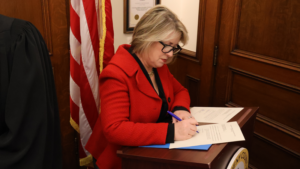
Acting Controller Amy Weise Clements assumed the office and duties of Allegheny County Controller upon the resignation of Corey O’Connor in January 2026. Amy was appointed Deputy Controller by former Controller Chelsa Wagner in 2012 and by former Controller O’Connor in 2022. Prior to this role, Amy was Budget Director for Allegheny County for eight years. She has been central to implementations of JDEdwards ERP software in three different governments, serving as Project Manager and in other roles. Previously, Amy headed the Auditing division in the Controller’s office and was an auditor at the firm Grant Thornton LLP. Amy earned her B.A. in Accounting from Indiana University of Pennsylvania and is a Certified Public Accountant in Pennsylvania. A Bethel Park native, Amy resides in the borough with her husband, Chip.
About the Office
The Allegheny County Controller’s Office performs a variety of duties essential to the operations of the County and to ensuring efficient and accountable government for its taxpayers.
The Accounting Division monitors the fiscal affairs of the County, processes more than 300,000 vendor payments annually, administers payroll, records and tags at‑risk and depreciable assets, reviews and inspects construction sites before approving progress payments, and produces financial reports in a variety of formats. This Division issues the Annual Comprehensive Financial Report (ACFR), an in‑depth annual assessment of County
finances in accordance with Generally Accepted Accounting Principles (GAAP), the Popular Annual Financial Report (PAFR), an easily understandable distillation of the ACFR geared for the general public, and financial dashboard reports available on the Controller’s website.
Through the Auditing Division, the Controller ensures that the County is achieving honest, efficient management, and full accountability in every aspect of government. The Controller may audit at any time any account of any agency receiving, disbursing, or authorizing the disbursement of County funds. This Division performs financial audits, performance audits, and attestation services that provide recommendations to County management and County Council to improve the economy and efficiency of County operations, ensure compliance with laws and regulations, and strengthens internal controls that safeguard County assets. The Auditing Division is peer‑reviewed, a distinction achieved by very few government auditing operations that recognizes adherence to the highest professional auditing standards.
The Division of Management Systems is responsible for maintaining financial management software while supporting the Controller’s office Enterprise Content Management (ECM) functions and sustaining the office’s hardware and software systems. This Division operates the JD Edwards (JDE) Service Center, which provides support for said enterprise resource planning system. The Service Center accepts more than 3,000 Help Desk calls annually from JDE users. This Division also manages the Controller’s Tableau and OpenGov platforms, which puts financial data from the JDE system into interactive, easily readable formats that enhance internal information sharing and public access to financial information alike.
The Administration Division houses staff dedicated to policy and budget analysis, special project management, community relations, intergovernmental affairs, legal counsel, communications and external relations, human resources, and executive management. In addition to supporting the other divisions’ ongoing efforts, the staff of the Administration Division work to further the goals and mission of the Office of the County Controller as the County’s fiscal oversight officer and taxpayer advocate. This is accomplished by the careful research and production of policy projects, the cultivation of key stakeholder relationships, and the continuing efforts toward making Allegheny County government, business, and actions more transparent and readily accessible to the public.
County Government




Population
The County saw a steep decline in international migration, likely due to federal immigration policy changes. If international migration had remained comparable to 2024, the population of the County would have grown for the first time since the 2020 decennial Census.
The most recent Census estimates for resident age (2024) show that Allegheny County has an older age structure than the country as a whole. In Allegheny County, 21.2 percent of residents are over the age of 65; nationally only 18 percent of the population was in that age bracket. At the other end of the age scale, 18.3 percent of Allegheny County residents were under 18, well below the national average of 21.5 percent.
Median Household Income & Poverty Rate
The poverty rate increased slightly to 11.7 percent in the most recent Census SAIPE estimate (2024), while the U.S. poverty rate declined from 11.1 percent in 2023 to 10.6 percent in 2024.
The poverty rate increased slightly to 11.7 percent in the most recent Census SAIPE estimate (2024), while the U.S. poverty rate declined from 11.1 percent in 2023 to 10.6 percent in 2024.
Employment
in 2024. The state of Pennsylvania’s real GDP grew 1.7 percent; both lagged behind the 2.4 percent increase that the U.S. as a whole saw.
The unemployment rate in Allegheny County for 2025 was 3.9 percent, slightly above the 2024 rate of 3.5 percent. However, it remained below the U.S. unemployment rate of 4.3 percent for 2025, and is still well below historical averages. Prior to 2022, the annual unemployment rate for Allegheny County had not fallen below 4 percent since at least 1990.
The number of employed persons in Allegheny County decreased by nearly 1 percent in 2025. Also, employment here still hasn’t returned to pre-pandemic levels, with annual employment 3.4 percent lower than it was in 2019. Meanwhile, for the country as a whole, which had already returned to pre-pandemic employment levels by mid-2022, employment stayed
flat in 2025.
Employment in Education and Health Services, the largest industrial sector in the Pittsburgh region, increased by 3.4 percent from 2024 to 2025. Other large sectors of the regional economy include Trade, Transportation & Utilities, which saw employment decrease 0.9 percent, and Professional & Business Services, where employment declined by 2.4 percent.
Housing
DHS BEHAVIORAL HEALTH SERVICES
The lack of a centralized waitlist system for most services requires clients to navigate waitlists across different providers on their own, which can lead to frustration or a reduction in motivation to receive treatment, the audit states. Clients may also sign up with multiple providers in an attempt to reduce their wait time, which can lead to a higher ‘no-show’ rate, wasting resources that could be used by other clients. Best practices in case management and administrative oversight require that client service waitlists be up-to-date, accurate, and regularly reviewed to ensure timely access to care. The Substance Abuse and Mental Health Services Administration (SAMSHA) also emphasizes prompt access to services and the elimination of administrative barriers.
The audit also found that OBH mental health, drug and alcohol, and general/program operations were budgeted for 87 staff positions as of December 31, 2024. Of these, 26 were unfilled. As of August 25, 2025,
there were still 25 unfilled positions.
911 CALL CENTER
Auditors surveyed Call Center employees on workplace conditions and collected data from 136 respondents. When asked to describe the overall culture of their workplace, 60 percent responded Very Negative or Negative.
When asked how comfortable the TCOs feel discussing mental health and stress with their supervisors, 58 percent responded Very Uncomfortable or Uncomfortable.
Auditors also interviewed 16 randomly selected TCOs. Thirteen interviewees told auditors that the Call Center does not have a positive workplace culture. Six interviewees said that management does not walk
the Call Center floor enough to interact with staff and observe Call Center operations.
Pension Fund
Fund Balance & Debt
The County ended 2025 with a General Obligation Bond Debt of $953.5 million, a decrease of $48 million over 2024. Debt levels represent about $778 for every County resident as compared to $813 as of December 2024. New bonds of $148.4 million were issued in 2024 to provide funding for the Capital Budgets for 2024 and 2025. A refunding that occurred in 2024 resulted in debt service savings of $2.2 million. While new bonds are to be issued in 2026 along with a refunding, the impact is yet unknown and debt service payments will likely remain at a minimum of $80 million through 2028. Managing debt levels continues to be a challenge as the County is responsible for maintaining 533 bridges and 408 miles of inter-municipal roads. Additionally, unanticipated problems caused by extreme weather events demand funding, including projects to remediate or prevent landslides.
Revenue
Other revenue streams continued to rebound and in some cases exceed pre-pandemic levels. Sales Tax increased by $3 million to $67.5 million, approximately $15 million more than in 2019.
State revenue increased $15.5 million, as Children, Youth and Family (CYF) Services Act 148 funding increased for housing, truancy, and after school programs.
Interest revenue fell $7.9 million due to decreased holdings of federal American Rescue Plan (ARP) funds as well as a decline in rates.
Expenditures
ARP spending covered considerable amounts of spending at the Jail and Kane Community Living Centers in 2024, so increases shown for 2025 are exaggerated. Actual expenditures for the Jail increased by $5.5 million. Spending at the Kanes actually fell by $1.3 million due to decreased spending on contracted agency nurses, which had escalated in recent years.
Children, Youth and Families (CYF) spending in the Department of Human Services increased by $28 million, with $18 million of this covered by increased state and federal allocations. The remaining $10 million represents increased County spending.
State & Federal Aid
On March 11, 2021, the American Rescue Plan (ARPA) was signed into law. It included $350 billion in State and Local Fiscal Recovery Funds (SLRF) to help state and local governments address the financial shock caused by the COVID-19 pandemic. Allegheny County received $380,998,452 from ARPA’s SLRF provision; half was received in May 2021 and the rest in June 2022. The funds can be used for costs incurred since March 3, 2021, had to be obligated by December 31, 2024, and must be spent by December 31, 2026. Using federal guidelines Allegheny County has budgeted $279 million of its SLRF money for Government Services, $36 million for Public Health, $57 million to address the pandemic’s negative economic impact, $9 million for stormwater mitigation, and $190,000 for administrative expenses.
Assessments
When an assessment is appealed, a hearing is held to determine the property’s current fair market value; that price is then multiplied by the Common Level Ratio (CLR), a figure set by the state to convert current market values to base year values. In 2022, a court ruling significantly reduced the CLR in Allegheny County, which made post-appeal assessment values much lower. At the same time there has been a substantial drop in demand for office space following the pandemic. As a result, many large commercial property owners filed appeals in 2023, and the total assessed value of property in the County fell by $756 million that year.
Since 2023, fewer parcels have been appealed, but those that were still led to significant drops in assessments. In 2025 property values were reduced by $440 million due to appeals; $157 million came from downtown Pittsburgh, where most of the County’s largest office buildings are located. Altogether, over the past three years property values in the County have fallen by nearly $1.8 billion as a result of appeals.
An interactive online dashboard developed by the Controller’s Office shows these changes in property assessment valuations. Users can see changes by school district, municipality, or City of Pittsburgh ward. Results can be seen for residential or commercial properties only, or for all properties together. Individual properties Downtown, which have seen large changes in valuation, are also shown. Along with the dashboard, the Controller’s Office website offers a Property Tax Estimate Worksheet, which can help property owners determine if they may benefit from an appeal, and an Assessment Appeals Guide outlining the process of appealing a property tax assessment.
Health & Wellfare
Kane Community Living Centers
The Kane Community Living Centers offer skilled nursing, long‐term care, and rehabilitation to the chronically ill and elderly who have limited financial resources through four facilities with a total of 1,166 licensed beds. ARP spending covered considerable amounts of spending at the Kanes in 2024, so increases shown for 2025 are exaggerated. Spending actually fell by $1.3 million due to decreased spending on contracted agency nurses, which had escalated in recent years. Occupancy held steady at 64 percent of capacity.
Court of Common Pleas Fifth Judicial District
provide alternative sentencing programs for adults and juveniles, including placement facilities and home detention.
The Highland Detention at Shuman
The Highland Detention at Shuman, which was closed in 2021 following revocation of its operating license, was reopened in July 2024 under management of non‐profit service provider Adelphoi. The facility reopened initially with 12 available beds, which is expected to eventually increase to 60. The Controller’s office, through its Construction Inspection and oversight functions, is monitoring renovation work and contractor payments. The cost of running this facility is captured under Human Services starting in 2024.
Allegheny County Health Department
The Allegheny County Health Department protects and improves public health through a variety of programs, including pollution monitoring, food poisoning prevention, rodent control, water testing, dental clinics, solid waste management, recycling, health education, and maternal and infant care.
Public Safety
Allegheny County District Attorney
The Allegheny County District Attorney is responsible for the prosecution of all Allegheny County criminal cases.
Allegheny County Emergency Services
Allegheny County Emergency Services oversees the countywide 911 network, responds to natural and man‐made disasters, assists municipalities with the training of firefighters, and investigates fires of suspicious origin.
Allegheny County Sheriff
The Allegheny County Sheriff is the chief law enforcement officer of the Courts,serves all writs and injunctions issued by the Courts, and provides transportation of those in custody to and from the Courts and the place of confinement.
Allegheny County Jail
The Allegheny County Jail detains and supervises those awaiting trial, accused of violating probation or parole, or serving given sentences. ARP spending covered considerable amounts of spending at the Jail in 2024, so increases shown for 2025 are exaggerated. Actual expenses increased by $5.5 million in 2025 as average daily occupancy grew by more than 6.5 percent to 1,834.
Allegheny County Medical Examiner
Allegheny County Medical Examiner investigates the circumstances, cause, and manner of sudden and unexpected deaths and medically unattended deaths, as well as provides laboratory services, technical assistance, and consultation to police departments, municipal officials, and County agencies.
Allegheny County Public Defender
The Allegheny County Public Defender provides legal counsel for indigent defendants and for respondents.
Allegheny County Police
The Allegheny County Police Department investigates all criminal activity that occurs on County-owned property and provides assistance to local police departments and other criminal justice agencies.
Parks & Recreation
Allegheny County Park
Allegheny County operates nine regional parks, which together comprise nearly 12,000 acres. These parks offer a wide range of amenities, including wooded areas with nature centers, biking and walking trails, picnic grounds, a golf course, the only downhill skiing available in Allegheny County, and other year-round sports and recreation facilities.
Allegheny County Regional Asset District (RAD)
The 2025 budget for the Allegheny Regional Asset District (RAD) authorized investments of $141.2 million in regional assets and operations, $1.5 million more than the 2024 budget. RAD is funded by
one-half of the additional 1 percent Sales Tax in Allegheny County. Allocations include nearly $10 million for projects at arts and cultural organizations, $1.2 million for six regional trail projects, and $6.7 million for parks. Libraries, parks and trails received 62.9 percent of the operating budget; sports facilities and the Convention Center 11.9 percent; arts and cultural organizations 12.4 percent; regional attractions (the Zoo, Phipps and Aviary) 8.5 percent; and transit 2.5 percent. In September 2025, RAD announced the expansion of its RAD Pass program to offer year-round free access to more than two dozen regional cultural and performing arts attractions to cardholders of Allegheny County libraries. Details can be found at RADPass.org.
Authorities & Other Entities
Community College of Allegheny County (CCAC)
Community College of Allegheny County (CCAC) enrollment for the 2025 spring semester stood
at 9,715 — up 4.5 percent from the previous year — at its four colleges and five centers. Tuition
remained comparatively affordable at approximately $8,800 annually for in-state students, helping
the college attract students facing rising costs at four-year universities.
ALCOSAN
The Allegheny County Sanitary Authority (ALCOSAN) has been recognized with a National Environmental Achievement Award (NEAA) for Operations and Environmental Performance, presented by the National Association of Clean Water Agencies (NACWA). The award honors ALCOSAN’s North End Plant Expansion: ALCOSAN’s New Outfall, a major milestone within
the authority’s long-term Clean Water Plan. The new outfall project modernizes critical infrastructure and supports regional water quality improvements. The project also marks the transition from ALCOSAN’s original Ohio River outfall (in continuous service since 1959) to the new North End outfall, which was commissioned on January 16, 2025.
Sports and Exhibition Authority (SEA)
In March 2026, the Sports and Exhibition Authority’s (SEA) Sports Commission approved $737,000 in grants for 19 upcoming local competitions, which it expects to generate a combined $69 million economic impact. These include the Pittsburgh Vintage Grand Prix held in Schenley Park each July and the Pittsburgh Marathon in November.
Allegheny County Airport Authority
The new Pittsburgh International Airport terminal opened for operations in November. While the project cost grew to roughly $1.7 billion from a projected $1.1 billion when it was announced, the authority described the new facility as a “right-sized” airport designed for current passenger demand while allowing for future growth. It has also been seen as a major improvement for travelers and airlines alike. The most substantial change is the elimination of the underground train connecting terminals, while other welcome enhancements include expanded baggage claim facilities and modernized parking.
Pittsburgh Regional Transit
The state authorized Pittsburgh Regional Transit (PRT) to shift $106.7 million in Capital funds to Operating expenses over two years to avoid service cuts and fare increases. While this could defer maintenance and delay modernization projects, the authority still plans $85 million in Capital spending during this period. Fiscal Year 2025 ridership was down 1.7 percent to 37.2 million, about 29 million below its pre-pandemic peak.
Tourism
While the recent NFL Draft is believed to be the largest event ever held in Pittsburgh, drawing an estimated 800,000 attendees, tourism is an important industry and revenue generator for Allegheny County every year.
According to VisitPITTSBURGH, the region’s official Tourism Promotion Agency, tourism generated an estimated $7.1 billion in economic activity from an estimated 21.5 million visitors in 2025.
These visitors contribute to a number of important revenue streams for Allegheny County. The 7 percent Hotel Tax, which is applied on the gross receipts of all hotel stays in the county (including short-term rentals) generated over $46.5 million in 2025, up $1.5 million from the prior year. The Controller’s Office helps to ensure the benefits of this tax to the community through its audits of select businesses subject to the tax. From 2022 through 2025, the Controller’s Office identified over $650,000 due to the County in unpaid tax.
Hotel Tax revenue is restricted to activities promoting tourism to the County, with several of these specified by law. Significant portions are dedicated to the region’s Tourism Promotion Agency, VisitPITTSBURGH; debt service on construction of the David L. Lawrence Convention Center and North Shore stadiums; and the Monroeville Convention Center.
The County’s General Fund also receives a collection fee on a portion of tax collected.
Revenues may also be directed to other agencies and initiatives that serve to promote tourism. In recent years, these have included the Pittsburgh Film Office and the Allegheny County Parks.
Tourism to the county also contributes to the 7 percent Alcoholic Beverage Tax and $2 per day Vehicle Rental tax dedicated to public transit activities and the 1 percent additional Sales Tax in Allegheny County, which supports the Allegheny Regional Asset District (RAD) as well as the County General Fund and municipalities.
The Heinz History Center was named number one history museum for the third year in a row in the USA Today Annual Readers’ Choice Awards, while the Children’s Museum of Pittsburgh was named number one children’s museum, and the Kamin Science Center ranked number three for science centers.
The History Center has announced an expansion that it will add a six-story wing, including a new visitors orientation center run by VisitPITTSBURGH.
SportsPITTSBURGH, an initiative of VisitPITTSBURGH, hosted the 50th anniversary edition of the Atlantic 10 Men’s Basketball Tournament at PPG Paints Arena in March, and will bring the NCAA Division II Men’s and Women’s Basketball Championships to the UPMC Cooper Fieldhouse at Duquesne University in 2026.
Anthrocon 2025, Pittsburgh’s annual ‘furry’ convention, broke its record number of attendees by hosting more than 19,000 people.
Coming attractions:
- Arts Landing, a four-acre destination in the Cultural District featuring a great lawn, bandshell, Garden Walk, family-friendly play area and more, is expected to hold its Grand Opening in June.
- Citizens Live at the Wylie, a new live music venue in the Lower Hill District, announced it will open October 2 with a performance by Pittsburgh-born rapper Wiz Khalifa. The venue will seat up to 4,300.
- The Esplanade in Pittsburgh’s Manchester-Chateau neighborhood—to include a Ferris wheel, splash park/ice skating rink, 225-room hotel, and marina—broke ground in December and is expected to be completed in 2028.
Although this report is largely based on Allegheny County’s 2025 Annual Comprehensive Financial
Report, this report is not prepared in accordance with generally accepted accounting principles (“GAAP”). Only the financial data for the general government is included in this report and, therefore, all of the County’s discretely presented component units are excluded.
Additionally, information is presented in a summarized manner and certain financial statements and note disclosures required by GAAP are omitted. A copy of this PAFR, as well as the County’s audited 2025 Annual Comprehensive Financial Report, which is prepared in accordance with GAAP, is located on alleghenycontroller.com.
The Government Finance Office Association of the United States and Canada (GFOA) has given an Award for Outstanding Achievement in Popular Annual Financial Reporting to Allegheny County, Pennsylvania, for its Popular Annual Financial Report for the fiscal year ended December 31, 2024. The Award for Outstanding Achievement in Popular Annual Financial Reporting is a prestigious national award recognizing conformance with the highest standards for preparation of state and local government popular reports.
In order to receive an Award for Outstanding Achievement in Popular Annual Financial Reporting, a
government unit must publish a Popular Annual Financial Report whose contents conform to program standards of creativity, presentation, understandability, and reader appeal.
An Award for Outstanding Achievement in Popular Annual Financial Reporting is valid for a period of one year only. We believe our current report continues to conform to the Popular Annual Financial Reporting requirements, and we are submitting it to GFOA.
Data Dashboards
Financial Dashboards
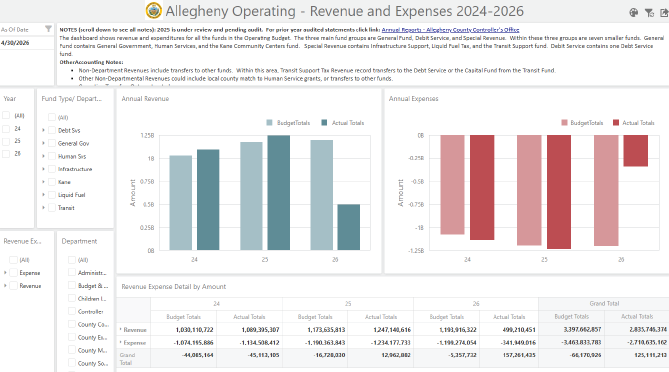
Operating revenue and expense data from 2014 to present day and down to departmental level is now available through the office’s Financial Dashboards using online platform Mobie.
“This easily usable platform provides improved access to up-to-date and historical budgetary data that is
most commonly utilized within County government and by the public alike,” Acting Controller Amy Weise Clements said.
“This is information that our public servants and decision makers need at their fingertips, and which
every member of the public deserves the ability to quickly access.”