
2024 Annual Reports
Popular Annual Financial Report & Annual Comprehensive Financial Report
Table of Contents:
Table of Contents
A message from the Controller
Citizens and friends of Allegheny County:

Thank you for once again allowing me to present the Popular Annual Financial Report (PAFR), which highlights our County’s fiscal conditions and some of the important work of the Controller’s office.
The daily efforts of our office are essential to presenting unbiased information on our government’s operations and financial standing. In the challenging environment we currently face, this work is invaluable, and I express my sincere gratitude to both my staff and those carrying out important duties throughout County government.
Our County faces concerning fiscal conditions arising from multiple factors. Property tax revenue, the County’s primary funding source, declined year‑over‑year for the first time in recent memory, owing primarily to a court‑ordered change in valuation methodology resulting in hundreds of millions of dollars in assessment reductions. Consequently, our rainy day fund was reduced by more than $30 million last year despite the use of $50 million in remaining federal emergency aid.
While the first millage increase in over a decade may prevent immediate service cuts in the coming year, our situation remains unsustainable. Neither further tax increases nor a County‑wide reassessment advocated by some would change the dynamic of rising costs combined with the exhaustion of federal pandemic aid and assessment reductions to large commercial properties.
The threat of federal funding cuts to essential Health and Human Services programs, including homelessness prevention and support systems, raises grave concerns., as does the prospect of significant service cuts by Pittsburgh Regional Transit (PRT), our County’s public transportation authority (see Pages 19‑20). Reductions in the Sales and Drink taxes show troubling economic indicators.
These challenges cannot permit us to turn away from the serious needs of many in our communities that are addressed through County functions. Through my office’s audits, we have sought to highlight both areas where efficiency and performance can be improved and where increased resources must be identified (see Pages 7‑8).
In our own operations, we have advanced cost‑saving improvements to payment of Election Day workers, partnered with the Treasurer’s office to improve collection of the County’s Hotel Tax, and conducted audits that would otherwise be contracted to outside vendors. I advocated for excluding elective bonuses from employee pension calculations, preventing harm to our Retirement Fund.
Ultimately, maintaining essential services and supporting our residents and communities will require increased resources generated by economic growth. We must focus on fostering development, especially in areas which have suffered from disinvestment. New housing can increase affordability and support underinvested business districts. Population growth that alleviates a shortage of working‑age adults can open the door to new industries. Convening all levels of government, business, organized labor, education and workforce institutions, the foundation community, and more to facilitate this growth must be an immediate and urgent priority for the County and its partners.
I am confident that with cooperation and resolve, we can put our region at the forefront of emerging economic trends and innovation to address the needs of our most vulnerable residents. But achieving this will require rising above longstanding divides and embracing new ideas. I am committed to using the unique role of the Controller’s office to advance these goals.
I hope for your partnership in these efforts, and that you find this report informative.
Sincerely,
Corey O’Connor
Controller, Allegheny County
About Controller Corey O'Connor

Corey O’Connor was appointed as Allegheny County Controller by then-Governor Tom Wolf in 2022. He then went on to win the most votes of any countywide candidate in both the primary and general elections in 2023.
Corey is committed to fostering accessible and transparent government that brings forthright solutions to our toughest challenges. Since becoming Controller, he has committed to reaching beyond Grant Street and has introduced new platforms for public access to government data. As Allegheny County’s fiscal watchdog and taxpayer advocate, he has audited major county departments, including the County Jail, Department of Economic Development, Department of Human Services, and the Department of Health. He has also proposed measurable benchmarks for County environmental and climate efforts, advocated for health and safety reforms for individuals incarcerated in the Allegheny County Jail, and enacted ethics reform measures on the Allegheny County Retirement Board, among other initiatives.
He serves on Allegheny County’s Retirement Board, Investment Board, Depository Board, and Jail Oversight Board.
Previously, Corey spent a decade on Pittsburgh City Council, where his accomplishments included authoring legislation to require annual audits of the Tax Abatement and Tax Increment Financing Programs, crafting the City of Pittsburgh’s Paid Sick Days Act, and creating the Joint Task Force on Construction Industry Fraud to increase accountability and prevent malpractice throughout the construction industry.
Corey is the youngest of three children of Pittsburgh’s late Mayor Bob O’Connor and Judy O’Connor. He resides in Point Breeze with his wife, Katie, and their children, Molly and Emmett.
About the Office
The Allegheny County Controller’s Office performs a variety of duties essential to the operations of the County and to ensuring efficient and accountable government for its taxpayers.
The Accounting Division monitors the fiscal affairs of the County, processes more than 300,000 vendor payments annually, administers payroll, records and tags at‑risk and depreciable assets, reviews and inspects construction sites before approving progress payments, and produces financial reports in a variety of formats. This Division issues the Annual Comprehensive Financial Report (ACFR), an in‑depth annual assessment of County
finances in accordance with Generally Accepted Accounting Principles (GAAP), the Popular Annual Financial Report (PAFR), an easily understandable distillation of the ACFR geared for the general public, and financial dashboard reports available on the Controller’s website.
Through the Auditing Division, the Controller ensures that the County is achieving honest, efficient management, and full accountability in every aspect of government. The Controller may audit at any time any account of any agency receiving, disbursing, or authorizing the disbursement of County funds. This Division performs financial audits, performance audits, and attestation services that provide recommendations to County management and County Council to improve the economy and efficiency of County operations, ensure compliance with laws and regulations, and strengthens internal controls that safeguard County assets. The Auditing Division is peer‑reviewed, a distinction achieved by very few government auditing operations that recognizes adherence to the highest professional auditing standards.
The Division of Management Systems is responsible for maintaining financial management software while supporting the Controller’s office Enterprise Content Management (ECM) functions and sustaining the office’s hardware and software systems. This Division operates the JD Edwards (JDE) Service Center, which provides support for said enterprise resource planning system. The Service Center accepts more than 3,000 Help Desk calls annually from JDE users. This Division also manages the Controller’s Tableau and OpenGov platforms, which puts financial data from the JDE system into interactive, easily readable formats that enhance internal information sharing and public access to financial information alike.
The Administration Division houses staff dedicated to policy and budget analysis, special project management, community relations, intergovernmental affairs, legal counsel, communications and external relations, human resources, and executive management. In addition to supporting the other divisions’ ongoing efforts, the staff of the Administration Division work to further the goals and mission of the Office of the County Controller as the County’s fiscal oversight officer and taxpayer advocate. This is accomplished by the careful research and production of policy projects, the cultivation of key stakeholder relationships, and the continuing efforts toward making Allegheny County government, business, and actions more transparent and readily accessible to the public.
County Government





Population
Between 2023 and 2024, Allegheny County gained an estimated 3,356 residents due to migration into the County. While domestic migration accounted for a loss of 5,192 residents, this was more than offset by a gain of 8,548 residents from international migration.
Population Groups
The most recent Census estimates (2023) show that Allegheny County has an older age structure than the country as a whole. In Allegheny County, 20.8 percent of residents are over the age of 65; nationally only 17.7 percent of the population was in that age bracket. At the other end of the age scale, 18.5 percent of Allegheny County residents were under 18, well below the national average of 21.7 percent.

Median Household Income & Poverty Rate
The poverty rate for Allegheny County increased slightly in the most recent ACS (2019‑23) to 11.6 percent and is above the U.S. average of 11.1 percent.
Countywide income and poverty rates obscure inequality across the municipalities of Allegheny County. For example, Rankin had a median household income of just $29,873 in the most recent ACS (2019‑2023), while at the other end of the spectrum, Fox Chapel’s median household income was more than $250,000. In Franklin Park, the estimated poverty rate was under one percent; in Braddock, the poverty rate was 36 percent. There are also huge racial gaps, with a 28.5 percent poverty rate for African Americans in Allegheny County versus 7.9 percent for white residents in the most recent ACS.
Employment
The number of employed persons in Allegheny County increased just 0.7 percent in 2024. However, employment here still hasn’t returned to pre‑pandemic levels, with annual employment 2.5 percent less than it was in 2019. Meanwhile, employment nationally returned to its pre‑pandemic level by mid‑2022, and in 2024 was 4.7 percent greater than in 2019.


Housing


Homeless Assistance Program
None of the six Bridge Housing programs contracted by the County reported being filled to capacity during any of the four quarters spanning July 2022 through June 2023. There were 447 individuals on the waiting lists for these programs as of the end of this period.

Meanwhile, several Emergency Shelter programs contracted by the County were at or near capacity for the entirety of the period. On average, an individual spent 47 days in an Emergency Shelter program, and 41 percent of individuals stayed more than 30 days, the DHS goal for moving individuals to longer‑term housing.
A Point‑in‑Time count conducted by DHS on January 30, 2024 showed an unhoused population of 1,164 people, an increase of 31 percent over 2020.
“While the impact of fully utilizing existing Bridge Housing would be relatively small numerically, it is a comprehensive program to get vulnerable individuals out of unstable housing and on the path to living independently. To leave any number of individuals out of having this option due to underutilization of our resources is unconscionable,” O’Connor said.
Auditors recommended that DHS monitor occupancy levels to identify which providers aren’t operating efficiently and work with providers to improve processes so occupancy levels can be increased.
READ THE FULL AUDIT REPORT
Clean Air Fund
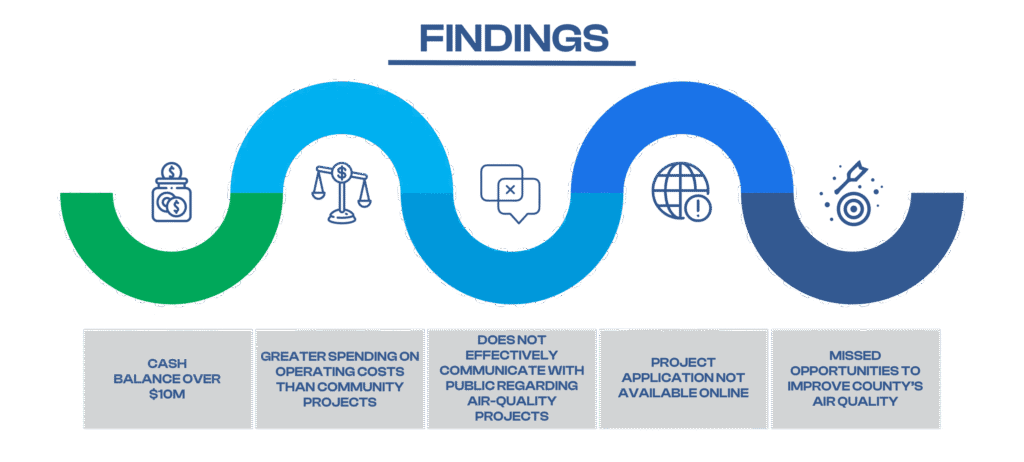
More than twice as much money was spent from Allegheny County’s Clean Air Fund on normal operating costs in two of three years examined by auditors than on projects to improve air quality and educate the public, the designated purposes of the Fund, an audit by the office of Allegheny County Controller Corey O’Connor found.
Administered by the Allegheny County Health Department (ACHD), the Clean Air Fund had a cash balance of more than $10 million for a significant portion of the audit period, January 2021 through September 2023. However, only a small portion of the cash balance ranging from 1.6 percent in 2023 ($157,565) to 6.1 percent in 2021 ($704,586) was used to fund air‑quality‑related projects annually.
“These funds are derived from fines for air quality violations that directly impact the communities where these industries are located,” O’Connor said. “That’s why it is critical — and the intention of the law that created the Clean Air Fund — that these communities are to benefit from additional projects to mitigate these harms. Our audit shows that the County has fallen far short of meeting this intent.”
Auditors found that a provision permitting ACHD to use up to five percent of the Fund’s balance at the end of the preceding year to fund normal operating costs of the Department’s Air Quality Program created an incentive for ACHD to retain a significant cash balance in the Clean Air Fund. This amounted to more than $1.7 million during the audit period. Meanwhile, just over $1.4 million was allocated to project expenditures.
The $489,000 permitted to be allocated for operating expenses in 2023 had not been transferred from the Fund as of the conclusion of the audit, and ACHD staff indicated to auditors it did not plan to do so. The Board of Health approved $4.1 million in grants from the Clean Air Fund in December 2024.
By ordinance, the Clean Air Fund is specifically for the disbursement of funds “to support activities related to the improvement of air quality within Allegheny County and to support activities which will increase or improve knowledge concerning air pollution, its causes, its effects, and the control thereof.”
The American Lung Association lists the Pittsburgh region as the 26th most polluted in the United States with respect to ozone and particle pollution.
“The repeated findings of elevated air pollution in Allegheny County are the strongest indicator that the Clean Air Fund must be used proactively and effectively to protect our residents. These millions are doing them little good sitting in the bank.”
READ THE FULL AUDIT REPORT
Pension Fund

Fund Balance & Debt

The County ended 2024 with a General Obligation Bond Debt slightly in excess of $1 billion, an increase of $109.8 million from 2023. Debt levels represent about $818 for every County resident as compared to $728 as of December 2023. A debt refunding that occurred in 2024 resulted in debt service reductions of $2.2 million and $800,000 in 2025 and 2026, respectively, but payments will increase to a minimum of $80 million for years 2025 through 2028. Managing debt levels continues to be a challenge as the County is responsible for maintaining 533 bridges and 408 miles of inter‑municipal roads. Additionally, unanticipated problems caused by extreme weather events demand funding, including projects to remediate or prevent landslides.

Revenue

State funding increased by $15 million, largely through increased Children, Youth and Family (CYF) Services funding for community violence prevention initiatives, new residential treatment facility programs, and $7.7 million in renovation and provider costs with the reopening of the Shuman Juvenile Detention Center. Charges for Services and Facilities increased by $12 million as the Kane Community Living Centers’ occupancy increased 8.3 percent, from 54.1 percent to 62.4 percent, bringing in an additional $11 million.

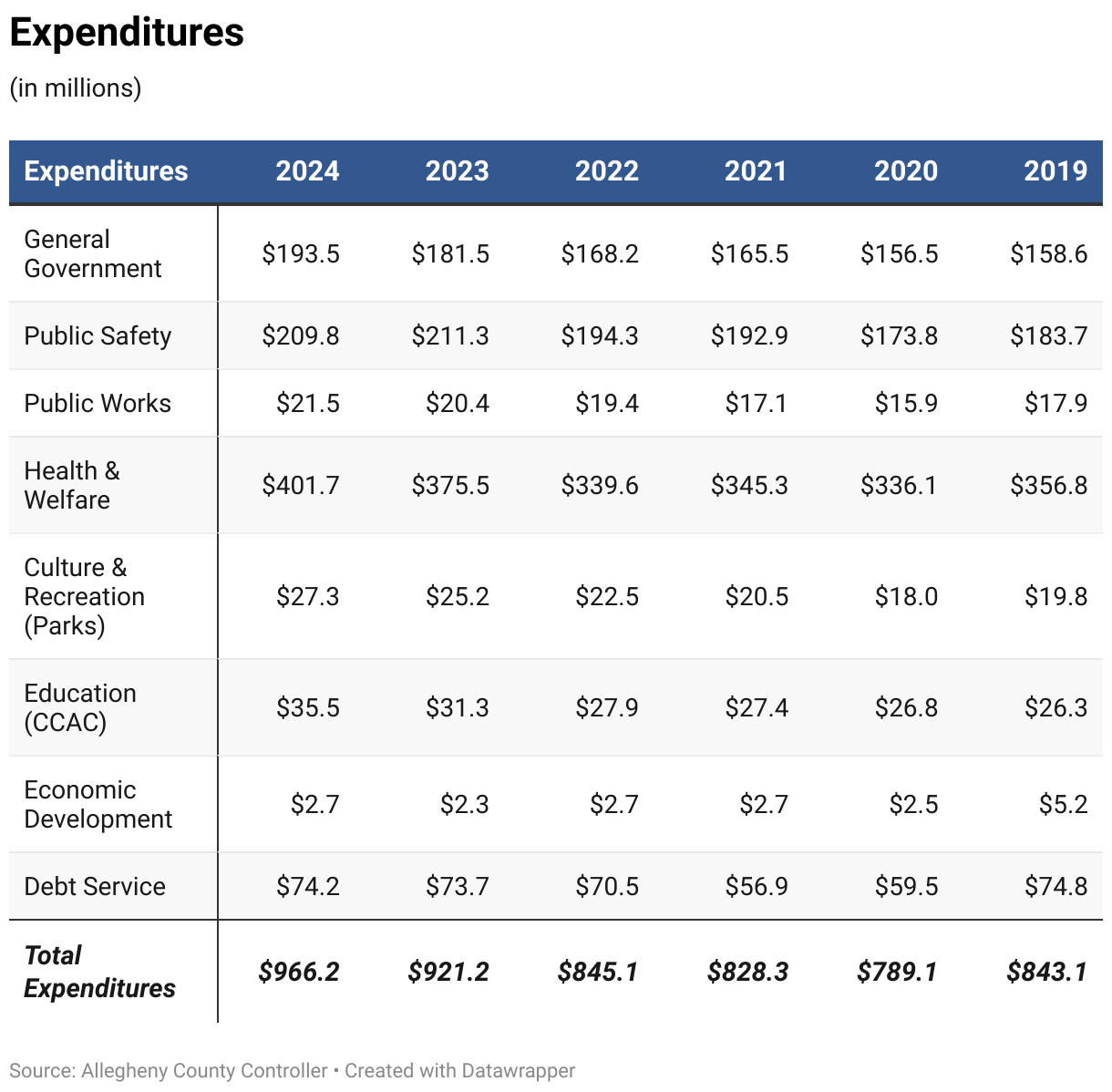
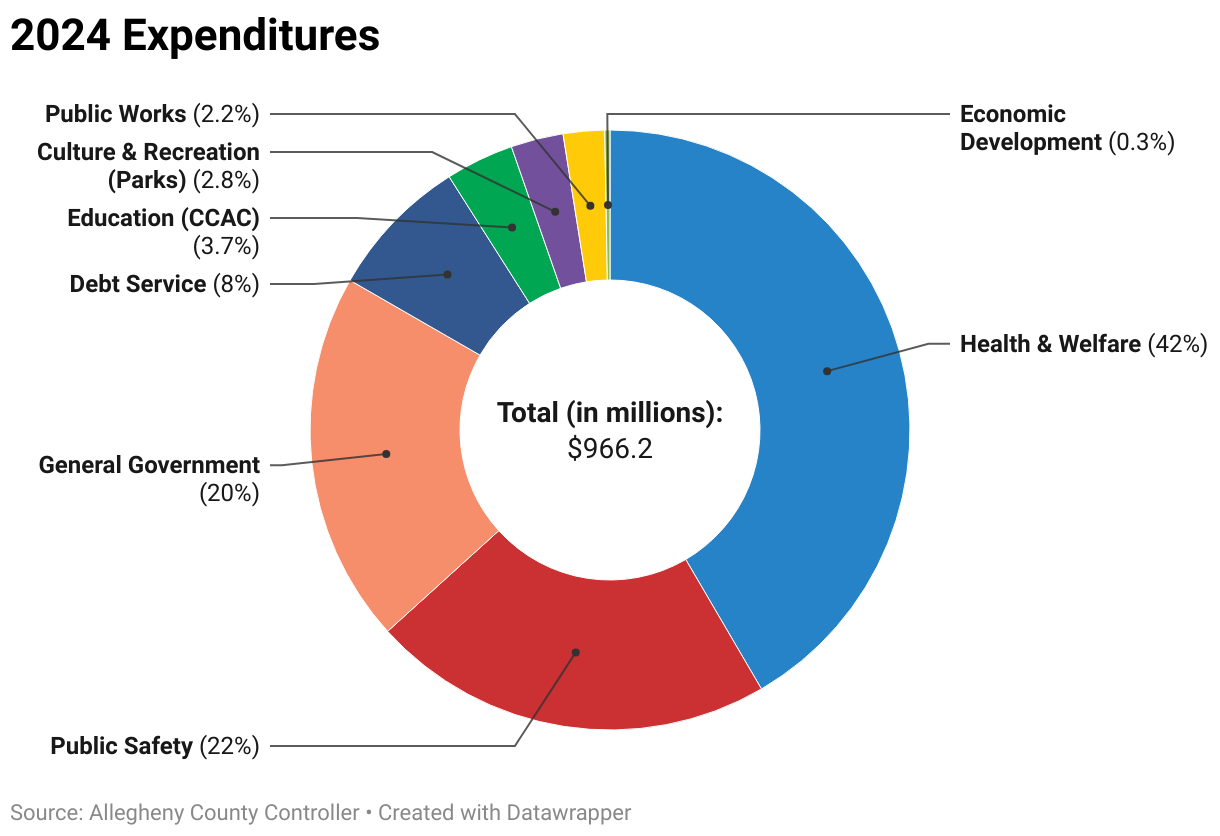
Expenditures
Increased Health & Welfare expenditures include $7.7 million for Shuman Center renovations and contracted management services.
Funding for Community College of Allegheny County (CCAC) was increased by more than $4 million.
State & Federal Aid
On March 11, 2021, the American Rescue Plan (ARPA) was signed into law. It included $350 billion in State and Local Fiscal Recovery Funds (SLFRF) to help state and local governments address the financial shock caused by the COVID‑19 pandemic. Allegheny County received $380,998,452 from ARPA’s SLFRF provision꞉ half came in May 2021 and the rest in June 2022. The funds can be used for costs incurred since March 3, 2021, and must be obligated by December 31, 2024, and spent by December 31, 2026. Using federal guidelines, Allegheny County has budgeted $270 million of its SLFRF money for Government Services, $38 million for Public Health, $64 million for aid to combat negative economic impact, $9 million for stormwater mitigation, and $190,000 for administrative expenses.

Assessments
Property taxes generate nearly half of the County’s revenue and an even larger share for many municipalities and school districts. The last countywide property reassessment was in 2012, meaning that most owners are paying taxes based on the property value determined then.
When a property’s assessment is appealed, a hearing is held to determine the property’s current fair market value; that price is then multiplied by the Common Level Ratio (CLR), which is set by the state to adjust for the increase in property values since 2012, to determine the new assessment value. In 2022, a court ruling significantly reduced the CLR in Allegheny County, which made post‑appeal assessment values much lower. At the same time, there was a substantial drop in demand for office space following the pandemic. As a result, many large commercial property owners filed successful appeals and the total assessed value of property in the County fell by $756 million in 2023.

In 2024, fewer properties were appealed and the decline in total assessed value wasn’t as steep꞉ $529 million. Assessment values in Downtown Pittsburgh, where most of the County’s largest office buildings are located, fell by just $127 million after appeals compared to a $454 million drop in 2023. Now that many large property owners have already had their assessment values lowered, we expect the decline in assessments to continue leveling off. However, the $1.2 billion total drop in assessments over the past two years alone means that the County, municipalities, and school districts will bring in tens of millions of dollars less in property tax revenue each year going forward. An interactive online dashboard developed by the Controller’s office shows these changes in property assessment valuations. Users can see changes by school district, municipality, or City of Pittsburgh ward. Results can be seen for residential or commercial properties only, or for all properties. Individual properties Downtown that have seen large changes in valuation are also shown. Along with the new dashboard, the Controller’s Office website offers a Property Tax Estimate Worksheet which can help property owners determine if they may benefit from an appeal and a Property Appeal Education Guide outlining the process of appealing a property tax assessment.

Health & Wellfare
Kane Community Living Centers
The Kane Community Living Centers offer skilled nursing, long‑term care, and rehabilitation to the chronically ill and elderly who have limited financial resources through four facilities with a total of 1,166 licensed beds. Average daily occupancy at the Centers grew by more than eight percent in 2024, but remained below pre‑pandemic levels. While this increased revenue by $12.7 million, spending increased by $7.3 million almost entirely due to contracted nursing costs. An operating deficit of $10.2 million would have approached pandemic-era levels without the use of $8 million in federal emergency funds for expenses. This deficit stood at under $4 million as recently as 2018.
Court of Common Pleas Fifth Judicial District
Court Programs provide alternative sentencing programs for adults and juveniles, including placement facilities and home detention.

Shuman Juvenile Detention Center
The Shuman Juvenile Detention Center, which was closed in 2021 following revocation of its operating license, was reopened in July 2024 under management of non‑profit service provider Adelphoi. The facility reopened initially with 12 available beds, which is expected to eventually increase to 60. The Controller’s office, through its Construction Inspection and oversight functions, is monitoring renovation work and contractor payments.
Allegheny County Health Department
The Allegheny County Health Department protects and improves public health through a variety of programs, including pollution monitoring, food poisoning prevention, rodent control, water testing, dental clinics, solid waste management, recycling, health education, and maternal and infant care.
Public Safety
Allegheny County District Attorney
The Allegheny County District Attorney is responsible for the prosecution of all Allegheny County criminal cases.
Allegheny County Emergency Services
Allegheny County Emergency Services oversees the countywide 911 network, responds to natural and man‑made disasters, assists municipalities with the training of firefighters, and investigates fires of suspicious origin.
Allegheny County Sheriff
The Allegheny County Sheriff is the chief law enforcement officer of the Courts, serves all writs and injunctions issued by the Courts, and provides transportation of those in custody to and from the Courts and the place of confinement.
Allegheny County Jail
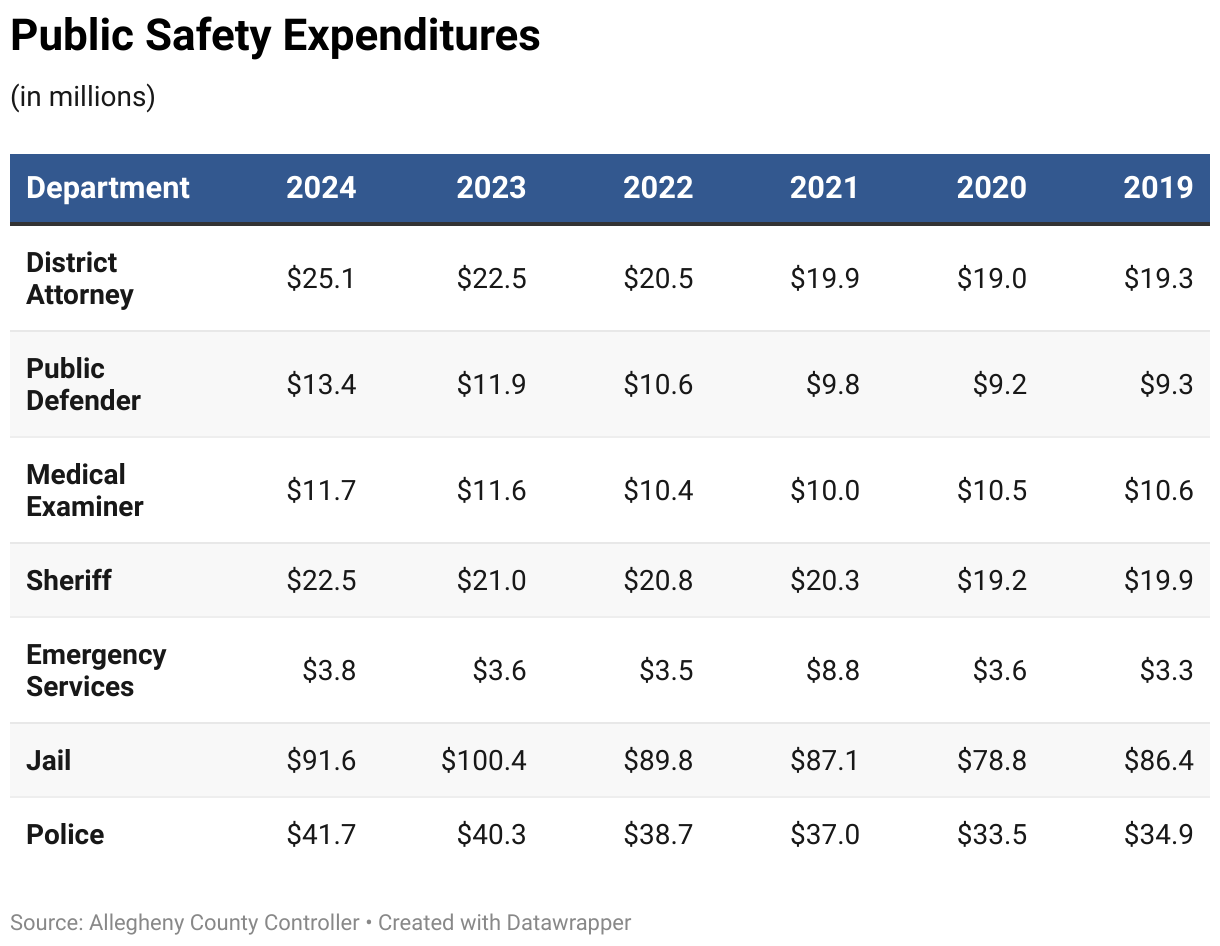
The Allegheny County Jail detains and supervises those awaiting trial, accused of violating probation or parole, or serving given sentences. Jail expenses increased by $15 million in 2024, largely due to overtime and contracted health care costs, but was offset by the use of $23.8 million in American Rescue Plan (ARP) funds.
Allegheny County Medical Examiner
The Allegheny County Medical Examiner investigates the circumstances, cause, and manner of sudden and unexpected deaths and medically unattended deaths, as well as provides laboratory services, technical assistance, and consultation to police departments, municipal officials, and County agencies.
Allegheny County Public Defender
The Allegheny County Public Defender provides legal counsel for indigent defendants and for respondents.
Allegheny County Police
The Allegheny County Police Department investigates all criminal activity that occurs on County‑owned property and provides assistance to local police departments and other criminal justice agencies.
Parks & Recreation
Allegheny County Park
Allegheny County operates nine regional parks, which together comprise nearly 12,000 acres. These parks offer a wide range of amenities, including wooded areas with nature centers, biking and walking trails, picnic grounds, a golf course, the only downhill skiing available in Allegheny County, and other year-round sports and recreation facilities.
Allegheny County Regional Asset District (RAD)
The Allegheny Regional Asset District (RAD) is funded through one‑half of the proceeds of Allegheny County’s one percent sales tax. The 2024 RAD budget authorized grants totaling $139.7 million, the highest in RAD’s history. These included a record $44.6 million to regional parks and trails, including the County’s North and Boyce parks, and a record $40.3 million to the public libraries of Pittsburgh and Allegheny County. RAD’s Summer Staycation program provides free admission to more than a dozen RAD-funded attractions to Pittsburgh and Allegheny County library card holders. For more information, visit RADPass.org.
Authorities & Other Entities
Community College of Allegheny County (CCAC)
Community College of Allegheny County (CCAC) announced the opening of its Electric Vehicle (EV) Automotive Technician training lab at the College’s West Hills Center in October 2024. The lab will house the nation’s first registered apprenticeship program for EV technicians and is expected to launch in spring 2025.
ALCOSAN
As part of its $2 billion Clean Water Plan to reduce sewage overflows into the region’s rivers and streams, ALCOSAN announced that the capacity of its treatment plant on Pittsburgh’s North Side is expected to increase to 295 million gallons per day by October 2025 from 250 million gallons currently. By October 2026, this is expected to increase to 480 million gallons. The complete overflow reduction project, which also includes the construction of storage tunnels and grants for green infrastructure projects to reduce system intake, is scheduled to be completed in 2036.
Sports and Exhibition Authority (SEA)
The Sports and Exhibition Authority (SEA) announced $10 million in upgrades to Acrisure Stadium, PNC Park and PPG Paints Arena in February 2025. Acrisure Stadium (the home of the Pittsburgh Steelers) and PPG Paints Arena (the Pittsburgh Penguins’ hockey arena) will undergo Wi‑Fi upgrades. PNC Park (the Pittsburgh Pirates’ baseball stadium) will see upgrades to accessible seating and team facilities. The PNC Park improvements are funded by ticket surcharges.
Allegheny County Airport Authority
The Allegheny County Airport Authority announced in March 2025 that its Terminal Modernization Project at Pittsburgh International Airport was more than 80 percent complete. The project includes a new 811,000‑square‑foot terminal and 5,000‑space parking garage. The Authority said in April that current cost projections for completion of the project had increased to $1.9 billion from $1.1 billion when the project was announced in 2019 and $1.57 billion in 2023. The project is funded by the airlines, Airport revenue sources, and federal grants. No County tax dollars are being used.
Crossroads
Pittsburgh Regional Transit (PRT), Allegheny County’s public transit agency (fomerly known as Port Authority Transit), stands at a crossroads. Even as a major infrastructure improvement project linking the region’s two largest employment centers takes shape and other ambitious service changes and innovations are planned and implemented, a budget shortfall risks decimating basic service for nearly 38 million annual riders.
The agency faces a large and growing operating deficit that it has said must result in a roughly one‑third decrease in service as well as fare increases without increased state funding.
While Gov. Josh Shapiro has proposed the first funding boost for public transit in a decade, this prospective $40 million increase for PRT represents only about a third of what the agency says it needs.
Along with service cuts that would leave many areas of Allegheny County without transit service altogether, end service after 11 p.m., and eliminate increased service for special events, the base fare would increase to $3, one of the highest among major urban transit agencies in the country. Paratransit service for physically disabled residents would be reduced by more than 60 percent.
The risk of major service cuts presents a roadblock for an agency that has been moving forward on many fronts.
The agency has reported that staffing increases have nearly eliminated a missed‑trip rate that stood as high as 18 percent three years ago.


PRTX
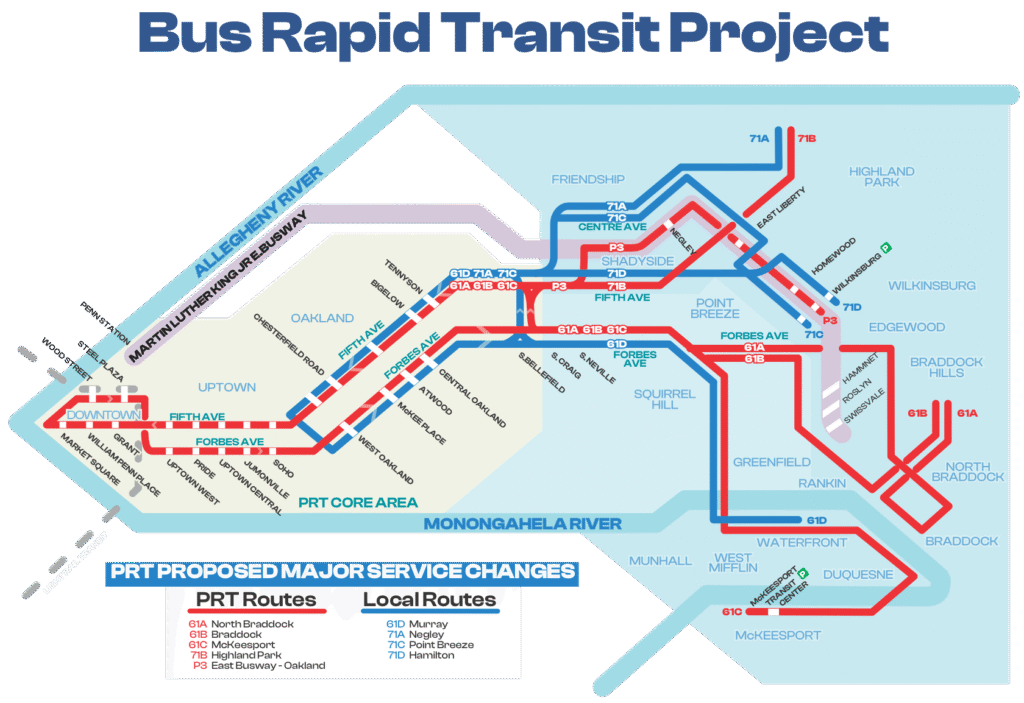
The $290 million University Line — a PRTX bus route that will travel along Fifth and Forbes Avenues between Oakland and Downtown Pittsburgh using mostly dedicated lanes and include enhanced amenities and accessibility improvements — is under construction and expected to be completed in 2027.
Reduced‑cost group passes for employers and apartment building owners and half‑cost passes for Supplemental Nutrition Assistance Program (SNAP) recipients were introduced last year.
A proposed route design that the agency says would generally reduce travel times and provide better service to employment centers, but which has been criticized by some riders and advocates, is undergoing public comment.
And the agency’s first climate action plan proposes that its operations become carbon‑neutral by 2045.
“There is no doubt that reliable public transit is essential to so many of our residents who need to get to work or school, grocery stores and medical appointments, and connect to all our region has to offer,” Controller Corey O’Connor said. “The fiscal standing of PRT in many ways mirrors that of Allegheny County꞉ costs have grown, revenues have been flat, and essential federal aid has dried up. But neither Allegheny County nor PRT can thrive without the other. Our communities need reliable transit access to attract investment and growth, which in turn can feed ridership and improve PRT’s finances.”
“In the near term, our elected officials, community and business leaders, and riders must advocate for the funds PRT needs to prevent devastating cuts and come together to plan sustainable solutions that can improve and secure public transit for the future.”
Drink & Vehicle Rental Tax
After topping $50 million for the first time in 2023, Drink Tax collections fell by nearly $3 million to $48.7 million. Barring the pandemic years of 2020‑21, this was the first time proceeds of the tax have declined since 2010, the first full year after a rate reduction to seven percent. Vehicle rental tax proceeds also declined by $200,000 to $7 million. Together, these taxes provide the County match for state funding of Pittsburgh Regional Transit ($40.5 million in 2024) and other public transportation initiatives at the discretion of the County. In 2024, $8.4 million was transferred to PRT for capital projects, double what was provided the previous year. The County also spent down a $42 million balance that had accrued in the Transit Fund by nearly $10 million by devoting $16.4 million to debt service on PRT projects, a large increase from previous years.

Although this report is largely based on Allegheny County’s 2024 Annual Comprehensive Financial Report, this report is not prepared in accordance with generally accepted accounting principles (“GAAP”). Only the financial data for the general government is included in this report and, therefore, all of the County’s discretely presented component units are excluded.
Additionally, information is presented in a summarized manner and certain financial statements and note disclosures required by GAAP are omitted. A copy of this PAFR, as well as the County’s audited 2024 Annual Comprehensive Financial Report, which is prepared in accordance with GAAP, is located on alleghenycontroller.com.
The Government Finance Office Association of the United States and Canada (GFOA) has given an Award for Outstanding Achievement in Popular Annual Financial Reporting to Allegheny County, Pennsylvania, for its Popular Annual Financial Report for the fiscal year ended December 31, 2023. The Award for Outstanding Achievement in Popular Annual Financial Reporting is a prestigious national award recognizing conformance with the highest standards for preparation of state and local government popular reports.
In order to receive an Award for Outstanding Achievement in Popular Annual Financial Reporting, a government unit must publish a Popular Annual Financial Report whose contents conform to program standards of creativity, presentation, understandability, and reader appeal.
An Award for Outstanding Achievement in Popular Annual Financial Reporting is valid for a period of one year only. We believe our current report continues to conform to the Popular Annual Financial Reporting requirements, and we are submitting it to GFOA.