
(Pittsburgh) June 1, 2026 In Annual Reports released today, Acting Allegheny County Controller Amy Weise Clements wrote that “the 2025 Property Tax millage increase has bought the County only a brief respite from considerable fiscal concerns.”
Weise Clements warned that with projected spending increases and the exhaustion of federal pandemic aid, “it will be challenging to do much more than break even this year.”
“Stability and growth will be key to reestablishing the County’s financial footing, but belt-tightening is also likely to be necessary,” she continued. Weise Clements—who has served in senior financial roles with the County for over 20 years and took office as Acting Controller in January—recommended particular scrutiny of spending within the County Department of Human Services (DHS) and the County Jail, which together have accounted for over $100 million in increased spending since 2019.
“Curtailing this cost growth without diminishing services is challenging but not impossible,” she wrote. “These departments must explore moving functions that are currently contracted at continually escalating cost in-house. Additionally, the Jail must finally take action to reduce reliance on employee overtime. Action in each of these areas would have the added benefit of bolstering the County’s Pension Fund, which continues to be hamstrung by a deficit of contributors to beneficiaries.”
She also urged the County administration to pursue payments from the region’s largest non-profits such as those recently secured by the City of Pittsburgh. “The County–our largest local government–cannot be a bystander as other bodies pursue fairness from these institutions,” she wrote.
She continued that while a prospective County-wide property reassessment would not improve the government’s immediate financial standing and would incur significant up-front costs, “it has become impossible to argue that embarking on this process is not long overdue. It is difficult for governments to plan, businesses to invest, or homeowners to have peace of mind under a shifting and uncertain taxation regime.”
The 36 percent property tax increase enacted for 2025—the first increase since 2012—provided additional revenue of $132 million. State revenue, primarily for Children, Youth and Family (CYF) Services, increased by $15.5 million.
General Fund expenditures increased by $79.7 million in large part because $32 million in Kane Community Living Centers and Jail expenditures were no longer being allocated to federal American Rescue Plan (ARP) grant funds, which will be fully exhausted this year. The County spent an additional $10 million from the General Fund for Human Services programs, augmenting increased state funding. Spending on the Kane Centers fell by $1.3 million as spending on contracted nursing services decreased by more than $3.5 million.
Increases in revenue streams like the Hotel, Drink and Sales taxes were encouraging economic indicators and should continue given large-scale events like the recent NFL Draft, the reports noted.
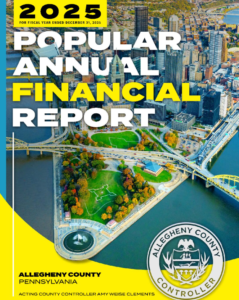
The Popular Annual Financial Report (PAFR) is an easily understandable presentation of the County’s financial and economic standing. The full report can be viewed here. An online version with interactive charts and graphs can be found here.
The Annual Comprehensive Financial Report (ACFR) is the complete, audited accounting of the County’s funds and component units. This report can be found here.
In conjunction with the release of the Annual Reports, Weise Clements announced new interactive online tools to provide public access to County budget and spending data.
Operating revenue and expense data from 2014 to present day and down to departmental level is now available through the office’s Financial Dashboards using online platform Mobie. A complementary dashboard shows cash balances and revenue and expenditure amounts for the County’s Special Accounts, which have not previously been accessible online. Special Accounts represent approximately $100 million of expenditures funded by restricted sources such as the Opioid Settlement fund, 911 operations, and the Child Support Enforcement fund.
“This is information that our public servants and decision makers need at their fingertips, and which every member of the public deserves the ability to quickly access,” Weise Clements said.